Tag: havsforskningsinstitut

what is happening to our fish.

Why are our fish missing.

click on image to read.

At Hustadvika the fishing has been nearly always good – sometimes though the fish disappear for some time – but they come back.

This year the fishing has been really bad – the fish disappearing from shallow water to much deeper – the rocks which usually had an abundance of small coalfish empty.

Fishing on the bigger shoals the fish are sometimes there but in strange places – down beside the rocks as if they were hiding or sheltering, and then only on one side and then suddenly gone.

Ashore at Askevågen, Vikan – there has been massive activity with the seaweeed trawlers.

Researching seaweed it was interesting to find out that they have very strong defence chemicals – in fact some even produce these defense chemicals in sympathy with damaged plants without being damaged themselves – these are mainly phlorotannins, Iodine, Bromine and later hydrogen sulphide as the damaged plants that are still attached start to rot.

According to research by the Norwegian marine biologists this effect can last for up to a year-

Fish are extremely sensitive to all these compounds – examining the tidal flow from askevågen – Vikan and yes it goes over the top of the rocks, spreading way out to sea and along the coast.

Further there is evidence that it is even affecting the lug worm beds at Kråkholm over 20 km away.

June 16 2013

monday 4.november 2025

At the seaweed trawling conference in Molde in 2018 Harald Bredahl a qualified marine biologist and responsible for the seaweed trawlers harvest said that he and Henning Steen a major figure in Norwegian marine biological research had discussed this and neither had heard of defence chemicals in Laminaria.

In Kjell Magnus Norderhaugs article on Nrk the national news station – he said that Norway had lost 5,000 sq kilometers of seaweed forest and that it was due to Global warming – he made no mention in this article about seaweed trawling.

Following research into norwegian seaweed trawling papers it is interesting to note there seem to be no mention at all about seaweed chemical defences.

In fact the only one we can find is in an unpublished paper by Nordenhaug in which he says very low concentrations strongly effect cod and coalfish.

If this is correct then it completely destroys the industrys stance that seaweed trawling is sustainable – in fact it even points to the massive changes in the marine ecology on our coast and the reason why.

This is most interesting because the earliest research we can find on commercial seaweed harvesting  a paper published in 1924 by the director of the plymouth marine biolgical laboratories – it says that if you clear away a patch in the laminaria seaweed forests seaurchins tend to move in and destroy the forest.

In 2000 it was noted that an area above Trondheim had a completely denuded seabed due to seaurchin predation – this area was some 2,000 sq km – the cause was put down to overfishing of cod which eat seaurchins –

Sea urchins have an important role – they clear organic matter from the seabed but they need to be kept in check, otherwise they attack the seaweed itself – This job is mainly done by many species of fish some of which are specially adapted to eating seaurchins but if they are driven away by poison plumes then the population explodes.

This chimes with what we have been told by other fishermen and landowners– sometimes just one pass of a seaweed trawler and the seabed becomes a urchin barren – other times especially if they hold themselves to regulations then they can harvest many times.

If one follows the path of seaweed for the alginate industry and study the process of production it is clear that animal epiphytes such as tube worms – small mussels etc make the production of alginate difficult – this is why the industry prefers younger plants than grow naturally.

So harvesting occurs every 4 or 5th year and it takes between 6 to 9 years for the seaweed beds to return to their former biodiversity and abundance – this means that pretty much the entire coast is effected by seaweed trawling in fact it is almost as if the industry is conditioning the seaweed forest for alginate production.– I am by no means an expert in marine biology – what I know must be common knowledge in the community – there must be extreme political or financial pressure to achieve this without the public becoming aware – further, for the regulating bodies not to put a full stop on these activities is to say the least against Norways grunnlåven 112.

These are maps downloaded from the fiskeriedirektoratets home page showing the harvesting areas for laminaria hyperborea on the Norwegian coast 13-12-2025.

overall view

enlargement of harvesting zones mid Norway – the darker areas are currently active-

close up of area currently harvested at Askevågen – Hustadvika.

The areas being currently harvested would produce plumes of defense chemicals following the tidal currents along the coast and swirling out to sea – as we have seen the effects travel many tens of kilometers – certainly far enough to reach the next zone currently being harvested.

Essentially this means that the state is knowingly sanctioning criminal activity which is effecting the livelihood of coastal fishers and others along pretty much the entire coast of Norway

In connection with this Kjell Magnus Nordenhaug in his article in the Norwegian national news service said that the estimated cost to the Norwegian people of the vanishing seaweed forest is about 7 billion kroner strangely enough about what the industry earns in destroying the seaweed forest.https://www.nrk.no/sorlandet/xl/omfattende-tang–og-taredod-koster-norge-7-milliarder-i-aret-1.17542729

Having attended and filmed the conference on seaweed trawling at Runde and at Trondheim it was strange to see no mention by the major marine biologists present of the damage seaweed trawling does – the only voice of dissent was at Runde in 2009 when Svein Håkon Lauritzen presented his paper on cormorants being unable to find enough food after seaweed trawling – this was soundly critiscised by Jostein Vea who says he is responsible for developing seaweed trawling on the Norwegian coast.

It was interesting to note that at the Trondheim conference seaweed trawling was not critiscised but harvesting by another mechanical means was, it was almost as if the representatives from the marine biology world were there to ensure there was no damage to the reputation of the seaweed trawling industry.

In fact it is almost as if the seaweed trawling industry owns the majority of Norways marine biologists.

Cleaner fish. 6 species taken from the wild for salmon farming because they eat fish lice.

In the 60and 70s i used to catch wrasse on the south west coast of england.

Always in the seaweed, and more often than not with the most beautiful markings and colours.

But there was a strange thing, they had teeth in their throats as well as in their mouths.  The teeth were on plates, presumably 2 plates worked against each other to grind things up.

I later learnt that indeed they were just for this.

Their food includes crabs,shrimps,hermit crabs, shellfish— and seaurchins. ( the destruction of the Norwegian seaweed forests are mainly attributed to seaurchins)

Of course it also includes fish lice this is why they are so important to the salmon farming industry.

Along the the coasts of many countries in europe and many other lands there is now a massive fishery for those fish. ( and other species)

They are caught live and transferred to the salmon pens where they live for up to 6 months before dying.  In other words there is a concerted effort to wipe out these species.

i have read a number of papers on wrasse, they hint that some species are territorial and are in fact gardeners.  That is they care for their patch by removing herbivores, and species of seaweeds they dont like.  Herbivores would include seaurchins.

Serious information seems remarkably difficult to come across – the question is why?

Here is a snippet from a  reply to a request for information to the scottish government concerning wrasse for the wrasse fishery.

It is dated 2019

STATEMENT OF REQUIREMENTS
1.1 Purpose

The purpose of this contract is to inform Scottish Natural Heritage’s views and build our
evidence base on the biodiversity implications of the fishery for cleaner fish , focusing on
the relevant protected sites and species. This will enable us to develop appropriate
advice on activities affecting features and relevant management measures in an area
which is currently data poor and consequently poorly understood. The contract will also
inform our thinking on the need to include cleaner fish species in the monitoring of the
MPA Network and enable SNH to assess the feasibility of this and develop appropriate
methodologies. The output from this project will also feed into wider work relating to
inshore fish species and support the Scottish Government inshore fisheries strategy


In other words THEY DONT KNOW what effects cleaner fish (wrasse) have on the ecology and what effects removing such a large number of fish will have in totto – several years after the fishery started.

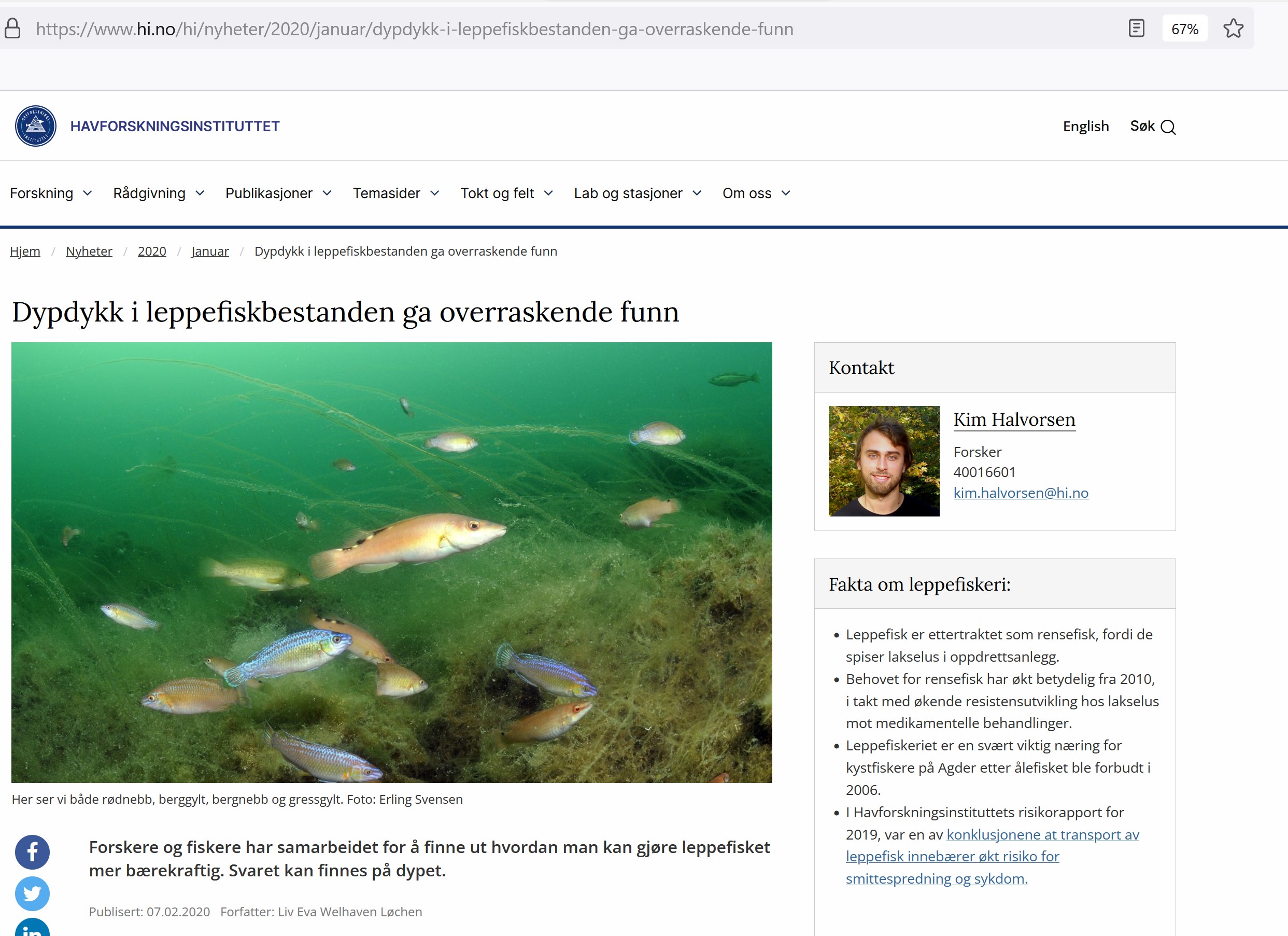
This is what the Norwegian havsforskningsinstitut has to say –

Forskere og fiskere har samarbeidet for å finne ut hvordan man kan gjøre leppefisket mer bærekraftig. Svaret kan finnes på dypet.

The leading sentence says – fishermen and researchers work together to see how one can make (lip fish – wrasse have big lips) leppefiskeriet

more sustainable – the answer is found in the deep.

In other words the answer to a more sustainable fishery is to catch more –
There are several more articles in the same vein – some more information on the fish themselves but it is fragmentary.

But here is one reinforcing the standpoint of this article

This involves many countries and has this to say  –

This project, and report, was initiated by researchers at the Institute of Marine Research (IMR) and builds upon several years of scientific work linked to the biology, fisheries and use of wild wrasse and lumpfish. Interactions with colleagues from Denmark, Sweden, Iceland, and the United Kingdom highlighted critical knowledge gaps which must be addressed to achieve sustainable fisheries of cleaner fish with minimal negative environmental impacts. Funding from the Nordic Council of Ministers enabled us to establish the present network of scientists and managers. Key topics were identified and discussed in meetings and workshops during the project period.

Again merely reinforcing the standpoint of this article that not enough research has been done, and this fishery has been ongoing since 2010 in Norway.

Question – does this show a disregard for the environment in spite of the current issues, that can be laid squarely at the door of big business?

An article from the Norwegian press
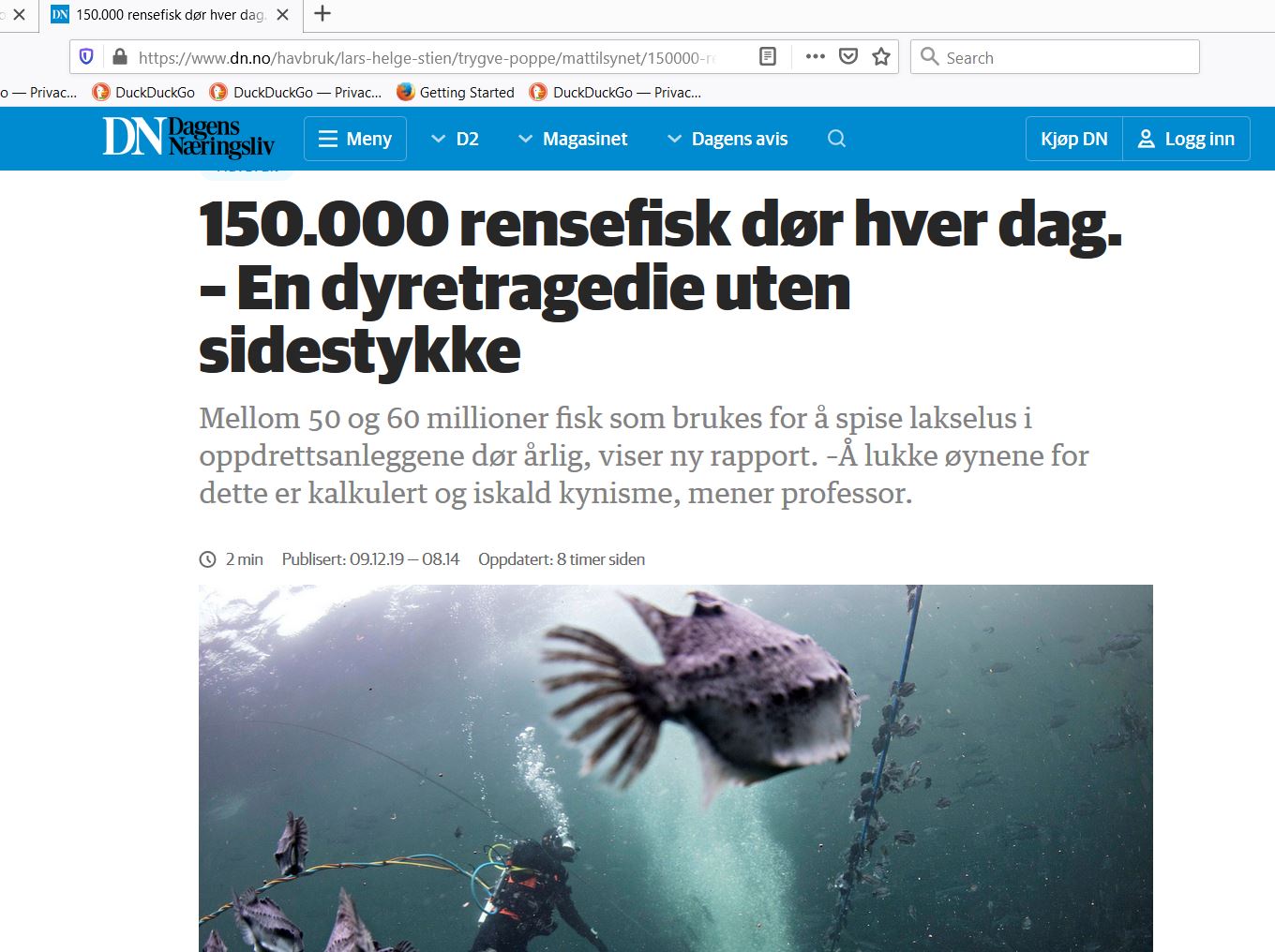
150,000 cleaner fish die every day, it is a animal tragedy without parallel.

This is not limited to Norway, but every country with salmon farming.

This is not sensible utilization of a natural resource.  If we want our seas to be a resource for future generations we have to do far better than this – Perhaps our research organizations are too close to industry  and our politicians are desperate to please the same.