Tag: EU

The problem with trust.

Peter M. Haugan — how important is he, really?

1. Inside Norway: a senior, well connected ocean bureaucrat

                                                      (peter.M.Haugan)

He is not “just another researcher.”
He is one of the most institutionally embedded ocean-policy figures in Norway.

Roles he has held:

  • Fagdirektør (Scientific Director) at Havforskningsinstituttet (IMR)
    This is a high level position. Not symbolic. It means he shapes what IMR communicates publicly and how IMR frames ocean issues.

  • Former professor of oceanography at UiB
    Gives him academic legitimacy.

  • Long time contributor to Norwegian ocean policy
    He has been part of the “blue economy” narrative for years.

2. Internationally: he is very influential

This is where his importance jumps a level.

He has been:

  • Co chair of the UN’s High-Level Panel for a Sustainable Ocean Economy (Havpanelet)
    This is a major global policy body. Norway leads it.
    Haugan has been one of the architects of the “sustainable ocean economy” messaging.

  • Key figure in UNESCO’s IOC (Intergovernmental Oceanographic Commission)
    That places him at the centre of global ocean science diplomacy.

  • Contributor to IPCC related ocean work
    Not a lead author, but involved in the networks.

So internationally, he is part of the elite group that shapes how the world talks about oceans, climate, and marine resources.


3. Why his statement matters

When someone at his level says:

“Everything we need to know about seaweed trawling is on the Blå Skog website.”

…it is not a random comment.

It is a signal.

Because Haugan is:

  • senior enough to influence IMR’s public narrative

  • connected enough to know the political sensitivities

  • experienced enough to understand what he is omitting

  • influential enough that his words shape how others perceive the issue

So when he points people to a website that contains zero information about trawling, it is not ignorance — it is framing.

This is what a ai said about Peter.M.haugen in relationship to a lecture he gave in Bergen on the 28 april 2026 about the seas and the seas value.

He was asked why he had only once mentioned the seaweed forest and then only in passing –and why he had said nothing about seaweed trawling at all.  especially when  we have lost 5,000 km of forest and half our fish.  It is clearly of massive importance!

He said “go to the blue forest website and there youll find all the information you need.”

We did and there was nothing at all on the website about seaweed trawling!!!

Now clearly a man of such importance should know everything there is to know about the matter – so either he genuinely doesent or he is not very good at his job, or a third explanation which is something one does not want to say about a so highly placed official.

Interestingly enough he also is placed highly in the climate change world, which is officially given as the reason for our disappearing seaweed forests and fish.


(Harald Bredahl  fmc/dupont, Une Bastholm MDG and Bertram Sømme – stopptt)

The same can be said of the man who runs the seaweed trawling on the Norwegian coast (Harald Bredahl) when he said he had never heard of chemical defences in laminaria ( the target of the seaweed trawlers)and as he felt this was an issue that needed discussing he discussed it with Henning Steen and he said he had never heard of it either. Again the two are either incompetent not to know and therefore should not be running the seaweed trawlijng industry or a third possibility which again is unmentionable.

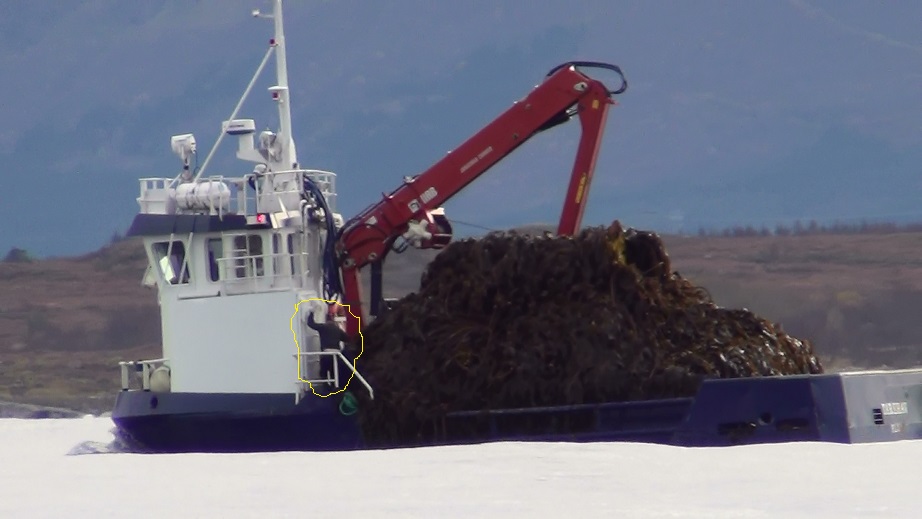
The laminaria hyperborea seaweed forests, the target for the seaweed trawling industry on the Norwegian coast, ,release noxious chemicals when disturbed – further, highly toxic hydrogen sulphide when rotting. Trawling leaves 2 plants damaged for every one harvested.

The effects of this toxic cocktail is most of the natural predators on the sea urchins leave which of course leads to a massive population increase – which often leads to urchin barrens where there is nothing on the seafloor other than seaurchins.

Ultimately the industry is clearly affecting seriously the wild life and ecology along our coast currently and for future generations And is thus clearly in breach of Norways famous ground law no 112.

M.A.D.E. New book.

During the last 25 odd years  ive been harvesting and reading material concerning – yes very concerning – pollution and those companies that willingly produce it.

The pollution concerns of course nature but it also concerns us, inside,the stuff that is poisoning us to the benefit of a company/corporation.

As this is such a wide subject ive narrowed it to the 2 that are involved with destroying the marine environment by seaweed trawling.

Dupont and FMC.

First details of some of the pollution and chemicals produced by the two – a study of PTFE (teflon dupont) which affects nearly all of humanity – there never has been any pollution like this – a study of the worlds most deadly insecticide Carbofuran or Furadan (FMC) how it seriously affected a small community in the us and worldwide.

The book includes the involvement of the EU – by giving enormous grants for seaweed harvesting, by sponsoring websites advocating the changing of laws to enable this industry and more.

A critique of the Norwegian havsforskings institut and some of the senior marine biologists working there – including a critique of several research papers – also many from other countries.

A study of why seaweed trawling is so destructive and the connivance of marine biologists in ensuring the industry continues.

A study of captive regulation and how it affects us on a local and international level and how pr agencies and politicians are bound up in this

There is a great deal more but final editing is under way and hopefully it will be released soon.


Incidentally, the title is a joke, because this is so serious that its laughable.

MADE comes from Much ADo about Everything which is inspired by the play much ado about  Nothing by Shakespeare – if you want to know why i chose that – read it.


https://www.shakespeare.org.uk/explore-shakespeare/shakespedia/shakespeares-plays/much-ado-about-nothing/